
Recent Episodes
View All






















Episode Collections

Discover how anxiety can become a space for spiritual growth, inviting us to depend more deeply on God and be formed into people of peace and courage.

Join David and Nancy French for conversations that bring honesty, humor, and hope to the toughest issues of faith, culture, and community.
Explore how faith can shape our politics through conversations rooted in hope, humility, and a shared pursuit of the common good.
From marriage to dementia to dying well, explore how friends who follow Jesus can navigate life’s hardest realities with courage, compassion, and a steady faith in what’s yet to come.

From AI to social media, Andy Crouch helps us discover how followers of Jesus can navigate technology with wisdom, discernment, and a vision for human flourishing.

Discover how we can nurture a resilient, thoughtful faith in the next generation—helping young people live with courage, curiosity, and conviction in a changing world.
Social Feed
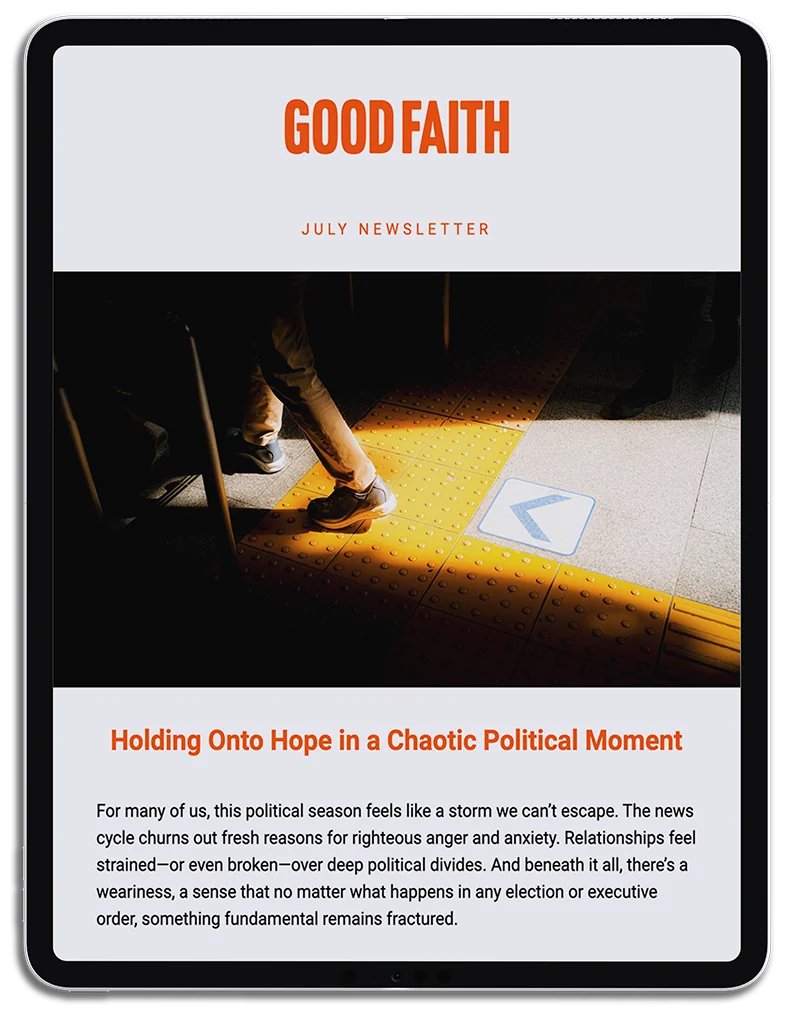
Want more Good Faith? Get on the Good List.
Each month, the Good Faith Newsletter lands in your inbox with insights from Curtis, reflections from our team, and a curated collection of the resources that are helping our team make sense of a complex world. You’ll find book recommendations, articles we’ve bookmarked, monthly playlists, and thoughtful resources to help you do the same.
It’s not just more content.t’s a monthly invitation to curiosity, reading widely, and thinking deeply. Sign up at the link in our bio.


What does it mean to live, and sing— faithfully in hard times?
Recorded live at the @southernadventistuniversity Illuminate Arts + Faith Conference, Matt Maher joins the Good Faith podcast to talk about protest, prophetic art, and the role of worship in telling the truth about pain. From Psalm 22 to Rich Mullins (a favorite topic of ours around here!), this conversation is about learning to sing honestly about suffering while still pointing to hope.
If you love Matt`s music now, you`ll love it even more after this conversation. Don`t miss it, listen in wherever you get your podcasts.

In a cultural moment defined by winning arguments rather than seeking them, this line from Owen Barfield, describing his legendary intellectual friendship with C.S. Lewis, lands like a quiet rebuke.
Guest Pete Wehner brings it into a conversation about Scripture, war, and the dangerous certainty of those who are sure God is entirely on their side. What would it look like for the church to debate for truth again? And where in your own life are you debating for victory, not for truth? This is the kind of conversation that might help us find out. Tune in wherever you listen to podcasts.

We don’t come to Scripture as blank slates.
We come with instincts, experiences, and assumptions. Often we don’t even realize all that we’re bringing with us when we open the Bible.
And if we’re not careful, we can begin to read Scripture in a way that simply confirms what we already believe,instead of allowing it to challenge and reshape us.
This isn’t a new problem. It’s one the church has faced again and again.
Which is why the real question isn’t just what does the Bible say but rather Am I willing to let God form me through his word?
For Christians, Scripture isn’t flat. It’s read through Jesus. Through the cross. And that means we don’t reshape it to fit our desires. We allow it to reshape us.

New bonus drop with N.T. Wright out now!
If last week with Pete Wehner reminded us why biblical interpretation matters, this conversation shows us how to begin.
N.T. Wright walks through what it looks like to study Scripture for yourself—drawing from history, context, and the wider world of early Christian writings to read the New Testament more faithfully.
It’s an invitation to go deeper, ask better questions, and grow in confidence as readers of the Bible.
And truly, there’s no better guide than N.T. Wright. Listen in wherever you get your podcasts.

This might be the most important sentence in any room where the Bible is being used to justify policy, war, or power. On the most recent episode of Good Faith, guest Pete Wehner names a sleight of hand that has caused immeasurable harm across Christian history: the quiet, often unconscious conflation of God`s Word with our reading of it.
None of us comes to the text from an entirely pure perspective. The question is whether we`re honest about what else is influencing (or even clouding) our interpretation of Scripture.
Tune is as Curtis and Pete wrestle through a conversation that is as urgent as today`s headlines and as old as the church itself. Listen in wherever you get your podcasts.

In a world moving faster toward digital connection, Scripture calls us back to something deeper.
Real presence. Real encouragement. Real community. We were never meant to follow Jesus alone—or at a distance.
The future may be shaped by technology, but our lives are still shaped by how we show up for one another.

As the U.S. war with Iran unfolds, voices like Pete Hegseth are invoking Scripture to frame violence and military action.
But what does the cross actually say? Don`t miss our latest conversation with Pete Wehner.

Quoting a poetic verse about enemies… and treating it like instructions for today?
That’s a category mistake. And in conversations about war, that mistake has real consequences.
Biblical literacy is more important than we could have ever imagined, and we`re seeing the consequences of not knowing how to read scripture properly in our politics. Let`s get on the same page about how we should approach scripture. Listen in to our latest conversation with Pete Wehner for more.

It’s easy to read the Easter story and wonder how the crowd got it so wrong.
Why choose Barabbas? Why reject Jesus?
But the story holds up a mirror. Because we’re often drawn to the same kind of power they were.
The kind that feels immediate. Visible. Effective. But Jesus refuses that path. And calls His followers to something different. Not the will to power—but the way of the cross.

When Scripture is used to justify violence, something has gone wrong.
Pete Wehner joins Curtis Chang to examine how biblical “holy war” texts are being invoked in modern politics, and why that should concern Christians.
From Iran to Washington, this conversation challenges us to rethink how we read the Bible, understand the character of God, and follow Jesus in a world shaped by power and conflict.
New episode out now. Don`t miss it.

Love is the most important part of being human—and it only exists between people.
You can like your devices. You can rely on them. But you cannot love them—and they will never love you back.
No matter how smart AI gets, it will never meet your deepest human need. Listen to our latest conversation with Andy Crouch for more.
